jaxēxa

jaxeexa

jaxēxa

We’re on the third sentence of the 18th Conlang Relay Text

samma japēlti mo jaxēxi ja ē ñi jarewēλi ī ñi jahūwi ī ñi jasēþa ñe jawēlrienāl rū jatāsa λi xēþa āñ;

The tūmse is barking at jaxēxi, the plural of jaxēxa which means smoke as a countable thing, so a plume, puff, cloud or wisp of smoke. Otherwise, the word for smoke is the sensibly collective anxēxi. jaxēxi is followed by the relative pronoun ja and then a number of conjoined ñi clauses.
japēlte

japeelte

japēlte

Here’s the third sentence of the 18th Conlang Relay Text

samma japēlti mo jaxēxi ja ē ñi jarewēλi ī ñi jahūwi ī ñi jasēþa ñe jawēlrienāl rū jatāsa λi xēþa āñ;

That one’s nice and long and complicated. The word japēlte, here in the plural, refers to a sound that an animal makes, so “barking” would be ok, or “bleating”. It’s plural, so there’s more than one sound, and it is the object of se, so something animate is emitting it, and the only animate animal we have is the tūmse from the second sentence. The mo phrase denotes the recipient of the barks (what the tūmse is barking at), and I will discuss that tomorrow.

annīsen

anniisen

annīsen

We’re on the second sentence of the 18th Conlang Relay Text

sū mamō salōmme ñi matūmse manīsen marēwa;

The word annīsen is another word I created for the relay. It means “carved or shaped with a knife” and inflected as an animate singular noun, it is modifying matūmse. Of course, since the previous sentence mentioned a statue, this only makes sense.

The next word is a form of anrēwa “awake”, so this sentence is:

“In the young man’s arms, the carved tūmse was awake.” or more literally, “the awake carved tūmse became [so]”.

jatūmse

jatuumse

jatūmse

We’re on the second sentence of the 18th Conlang Relay Text

sū mamō salōmme ñi matūmse manīsen marēwa;

The word jatūmse refers to a small predator often kept as a pet. So, cat or ferret or dog or some other sort of small predator kept as a pet. In this text, the word has been elevated to animacy (or personhood), making it an actor in the story.

mamō

mamoo

mamō

Here’s the second sentence of the 18th Conlang Relay Text

sū mamō salōmme ñi matūmse manīsen marēwa;

The word mamō refers to a young man. The word in the text I got talked about a boy, but this did not fit with the idea of who this character ought to be. As I mentioned earlier, with a little tweaking, this story was about two legendary Kēleni culture-heroes. Using the word for young man rather than boy was part of the tweaking.

The locative phrase sū mamō salōmme is “In the young man’s arms…”.

janūwa

januuwa

janūwa

Continuing with the first sentence of 18th Conlang Relay Text:

ñi jakāellīñ jarēspe sū janūwa ī;

So we have “the kāellīñ was stirring” and then a locative phrase for the location of the kāellīñ. janūwa means “corner”, specifically interior corner like the inside of the elbow or where two walls come together. sū janūwa is “in or at the corner”.

The sentence ends with the particle ī, which, coming at the end of the sentence as it does, signifies that this is not the first time that this has happened.

ñi jakāellīñ jarēspe sū janūwa ī;
The kāellīñ was stirring in the corner again.

anrēspe

anreespe

anrēspe

Continuing with the first sentence of 18th Conlang Relay Text:

ñi jakāellīñ jarēspe sū janūwa ī;

The next word is the stative noun anrēspe in inanimate singular to modify jakāellīñ. anrēspe refers to motion in place, and does not further specify what type of motion, only that something is in one place and there is motion. ñi jakāellīñ jarēspe then is saying that the kāellīñ has changed its state to moving-in-place. Or, “the kāellīñ was stirring”.

jakāellīñ

jakaaelliinj

jakāellīñ

Finally, the 18th Conlang Relay text. I loved this text. With a little tweaking (which I did, of course) it was a story about two legendary Kēleni culture-heroes. 🙂

The first sentence is:

ñi jakāellīñ jarēspe sū janūwa ī;

And right away, as the object of ñi, we have an unfamiliar word. I had to create this word for the relay, though I had the concept of the thing already. I also had to create related words, of course. Anyway, jakāellīñ refers to a small (6-30 inches in height) statue, traditionally carved from jade (ankāelle) though other materials can be used. Traditional subjects for jakāellīñi include deities, heroes, ancestors, animals, and sometimes trees. They are usually displayed in niches decorated with cloth and plant matter, and they are considered lucky. They are not used directly as idols or for worship, despite the fact that many have a religious significance.

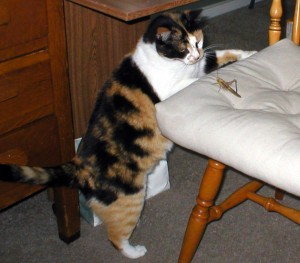
Cat vs Grasshopper

Every so often DC gets bored with traditional cat toys and goes after something that moves on its own.

P4260005

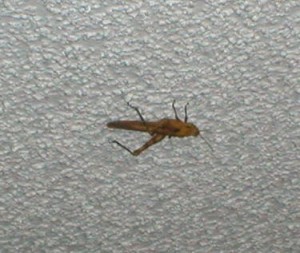
After a while the grasshopper got away. It then took refuge on my ceiling for several days.

P4270010

This did not make me happy. I said to myself, “What if gravity should exert itself while I am sitting underneath it? Bad kitty.”

However, eventually my wonderful goddaughter came by to catch the grasshopper and release it back into the wild, where I am sure it will live happily ever after or until my cat catches it again.